
Create an Industry-leading
Manufacturer of Premium Quality
SPA Hot Tub
Manufacturer of Premium Quality
SPA Hot Tub
Views: 0 Author: Site Editor Publish Time: 2026-11-17 Origin: Site


Procuring high-capacity spas for commercial properties carries significantly higher stakes than residential purchases. Equipment failure directly impacts guest satisfaction and revenue. Hotels, resorts, and luxury rentals rely on these amenities to drive bookings. Balancing upfront capital expenditure with long-term operational durability remains a constant challenge. Buyers must navigate a fragmented market of manufacturers to find units that withstand high bather loads. These units must meet stringent health codes and minimize maintenance downtime while delivering a premium guest experience. This guide provides a technical evaluation framework for sourcing an 8 person hot tub at scale. We analyze component reliability, architectural integration, and supplier vetting criteria. You will learn how to evaluate shell materials, filtration systems, and structural requirements. We also cover compliance standards and risk mitigation strategies to ensure a compliant investment for your property.
Component Quality Dictates Lifespan: Prioritize industry-standard materials like an Aristech acrylic hot tub shell, composite exterior cabinetry, and proven electronics (e.g., Gecko or Balboa) to mitigate premature wear in high-traffic environments.
Compliance is Non-Negotiable: Commercial hot tubs require specialized filtration, rapid turnover rates, and automated sanitation systems to meet local health department regulations.
Supplier Support Outweighs Unit Price: When sourcing an 8 person hot tub wholesale, guaranteed parts availability, local commissioning support, and commercial warranty terms are more critical to ROI than the initial bulk discount.
Infrastructure Planning is Critical: An 8-person unit requires substantial structural reinforcement (often exceeding 6,000 lbs filled), dedicated high-amperage electrical circuits, and careful consideration of in-ground versus above-ground placement.
Defining actual spatial requirements prevents overcrowding and guest discomfort. A true eight-passenger unit requires a specific interior layout. Manufacturers often measure capacity by counting potential seating positions. Not all seating designs accommodate adult guests comfortably. You must evaluate the difference between open seating and lounge seating before making a procurement decision.
Open seating maximizes bather capacity. It provides upright, bench-style positions around the perimeter. This layout allows guests to move freely and socialize without overlapping legroom. Lounge seating features reclined, full-body massage chairs. While luxurious, a single lounge seat consumes the space of two standard seats. Lounge designs reduce overall capacity and restrict movement. They are rarely ideal for high-turnover commercial environments. Prioritize open seating layouts to ensure your unit genuinely accommodates eight adults simultaneously.
Water displacement presents another physical reality. When eight adults enter a 500-gallon vessel, the water level rises significantly. You must specify units with high-capacity skimmers and adequate freeboard space. Insufficient freeboard causes water to spill over the edges, creating slip hazards on the surrounding deck and constantly triggering the auto-fill valve.
Integrating commercial hot tubs requires careful architectural planning. You must choose between in-ground and above-ground installations based on site constraints. In-ground or vaulted installations offer a seamless, high-end resort aesthetic. They sit flush with the surrounding deck, providing easier accessibility for guests with mobility challenges. Vaulted designs require complex drainage systems. You must install high-capacity sump pumps in the vault to prevent groundwater from flooding the equipment compartment.
Freestanding above-ground units offer distinct operational advantages. They eliminate the need for costly excavation and concrete vault construction. Maintenance staff can easily access plumbing and equipment panels. You simply remove the exterior cabinet panels to reach pumps, heaters, and gate valves. Above-ground units also allow for easier relocation if property layouts change.
Consider building raised decking around an above-ground unit. This hybrid approach provides the built-in aesthetic while maintaining equipment accessibility. You construct a wooden or composite deck that meets the acrylic lip of the spa. Ensure you build removable trap doors into the deck design. Technicians need at least 36 inches of clearance to perform routine maintenance or replace a failed pump.
Commercial settings impose severe operational demands on spa equipment. Continuous use stresses every component. Varying bather hygiene introduces heavy organic loads into the water. Lotions, oils, cosmetics, and sweat overwhelm standard residential filters. Frequent water cycling forces pumps to run continuously. These factors push the shell, plumbing, and filtration systems far beyond normal limits.
You must establish strict baseline durability requirements. Residential units often fail within months under commercial strain. Specify continuous-duty circulation pumps designed for 24/7 operation. Demand high-density plumbing lines secured with heavy-duty clamps rather than standard PVC glue joints. The structural frame must resist moisture and rot.
Galvanized steel or pressure-treated synthetic frames outperform standard wood frames. Wood frames absorb ambient moisture from the equipment compartment, leading to rot and structural collapse. Equipment longevity relies on over-engineering every internal system. Specify oversized filtration manifolds and heavy-duty gate valves to isolate pumps during repairs.
Regulatory compliance dictates commercial spa design. Local health departments enforce strict safety standards. Failing to meet these codes results in immediate closure and liability exposure. Standard residential units rarely meet commercial health codes out of the box. You must verify compliance before finalizing any purchase.
Mandatory safety features include emergency shut-off switches. These must be clearly visible, accessible, and located at least five feet away from the water's edge. Depth markers must be permanently etched or tiled into the shell. Stick-on decals degrade quickly and fail inspections. Drain covers must comply with the Virginia Graeme Baker (VGB) Pool and Spa Safety Act. This prevents entrapment hazards by utilizing dual-drain systems spaced at least three feet apart.
Commercial codes also require automated chemical feeders. These systems maintain precise sanitizer levels during peak usage. You cannot rely on floating dispensers. Install an ORP (Oxidation-Reduction Potential) controller that automatically injects liquid chlorine or acid based on real-time water chemistry readings. Verify all local regulations with your municipal health inspector during the planning phase.
The spa shell serves as the primary structural and aesthetic component. It must resist blistering, delamination, and chemical degradation. Manufacturers use various materials, including acrylic, rotomolded plastic, and fiberglass. Cast acrylic remains the gold standard for commercial applications. It offers a non-porous, UV-resistant surface that withstands heavy daily cleaning.
Specifying an Aristech acrylic hot tub shell ensures long-term durability. Aristech surfaces resist scratching and fading. The acrylic sheet requires substantial backing to maintain rigidity. Look for high-density polyurethane foam or layered fiberglass reinforcement. Factory technicians hand-roll the fiberglass backing to eliminate air bubbles. This backing prevents the shell from flexing under the weight of eight adults. Flexing leads to micro-cracks and eventual leaks in the plumbing lines attached to the jet bodies.
Shell Material | Manufacturing Process | Commercial Durability | Maintenance Profile |
|---|---|---|---|
Cast Acrylic (e.g., Aristech) | Vacuum-formed sheet with fiberglass/resin backing | Excellent. Resists UV, chemicals, and heavy loads. | Low. Non-porous surface wipes clean easily. |
Rotomolded Plastic | Heated plastic powder rotated in a mold | Moderate. Extremely tough but prone to dulling. | Medium. Surface can stain and requires specialized cleaners. |
Standard Fiberglass | Gelcoat sprayed over a fiberglass mold | Poor. Prone to blistering and spider cracking. | High. Gelcoat degrades rapidly under commercial chemical loads. |
Exterior cabinetry protects internal components from weather and pests. Traditional wood siding requires constant maintenance. It fades, warps, and rots in damp commercial environments. Wood cabinets demand annual sanding and staining. This increases your facility's maintenance burden and disrupts the guest experience during upkeep.
Modern composite or synthetic cabinetry solves these issues. Commercial units require UV-resistant, rot-proof composite sides. These materials mimic the look of natural wood or stone. They withstand harsh weather and frequent exterior cleaning. Maintenance staff can pressure-wash composite cabinets without causing damage. High-quality synthetic siding maintains its appearance for years, protecting your property's visual standards. Ensure the cabinet panels feature quick-release latches rather than standard screws to speed up maintenance access.
The control system acts as the brain of the spa. It manages heating, filtration cycles, and pump operation. Avoid proprietary control systems. Proprietary parts limit your repair options and inflate replacement costs. Universal, serviceable platforms offer superior reliability and widespread parts availability.
Specifying a Gecko control outdoor spa system provides significant operational advantages. Gecko and Balboa represent the industry standard for commercial electronics. They feature intuitive diagnostic codes. Maintenance staff can easily identify sensor failures or heater faults by reading the topside display. Replacement circuit boards remain readily available through local supply houses.
These systems utilize robust titanium heater elements. Titanium resists scale buildup and chemical corrosion better than standard stainless steel. In a commercial setting, fluctuating pH levels quickly destroy cheap heater elements. A 5.5kW titanium heater provides rapid temperature recovery when multiple guests enter the water, ensuring the spa remains at the target temperature during peak hours.
Commercial bather loads overwhelm standard residential filtration. Eight guests introduce significant contaminants into a small water volume. You must specify high-flow, continuous-duty circulation pumps. These pumps move water through the filters 24 hours a day. Rapid water turnover prevents cloudy water and bacterial growth.
Secondary sanitation systems act as mandatory additions. Ozone generators and UV-C sterilizers neutralize waterborne pathogens. They destroy chloramines, which cause strong chemical odors and skin irritation. Utilizing Ozone and UV-C reduces your reliance on heavy chlorination or bromination. This protects equipment from chemical degradation. It drastically improves the guest soaking experience by eliminating red eyes and dry skin.
Specify commercial-grade cartridge filters with at least 100 square feet of filtration media. Dual-filter systems allow the skimmer to pull water from the surface while a secondary suction fitting pulls water from the footwell. This ensures complete debris removal from all depths of the vessel.
Luxury features attract guests, but they also introduce failure points. You must analyze the return on investment for every amenity. Prioritize durable visual and hydrotherapy upgrades. Multi-pump configurations ensure strong jet pressure across all eight seats. LED waterline lighting creates a premium evening ambiance without adding mechanical complexity. Simple, gravity-fed waterfalls add soothing audio without requiring dedicated plumbing lines.
Avoid high-failure-rate accessories in commercial environments. Built-in stereos, pop-up speakers, and integrated televisions fail rapidly. Moisture, heat, and heavy guest usage destroy consumer electronics. Repairing these features requires draining the unit and removing cabinet panels. Provide external, waterproof Bluetooth speakers on the surrounding deck instead. Keep the spa equipment focused entirely on hydrotherapy and water quality.
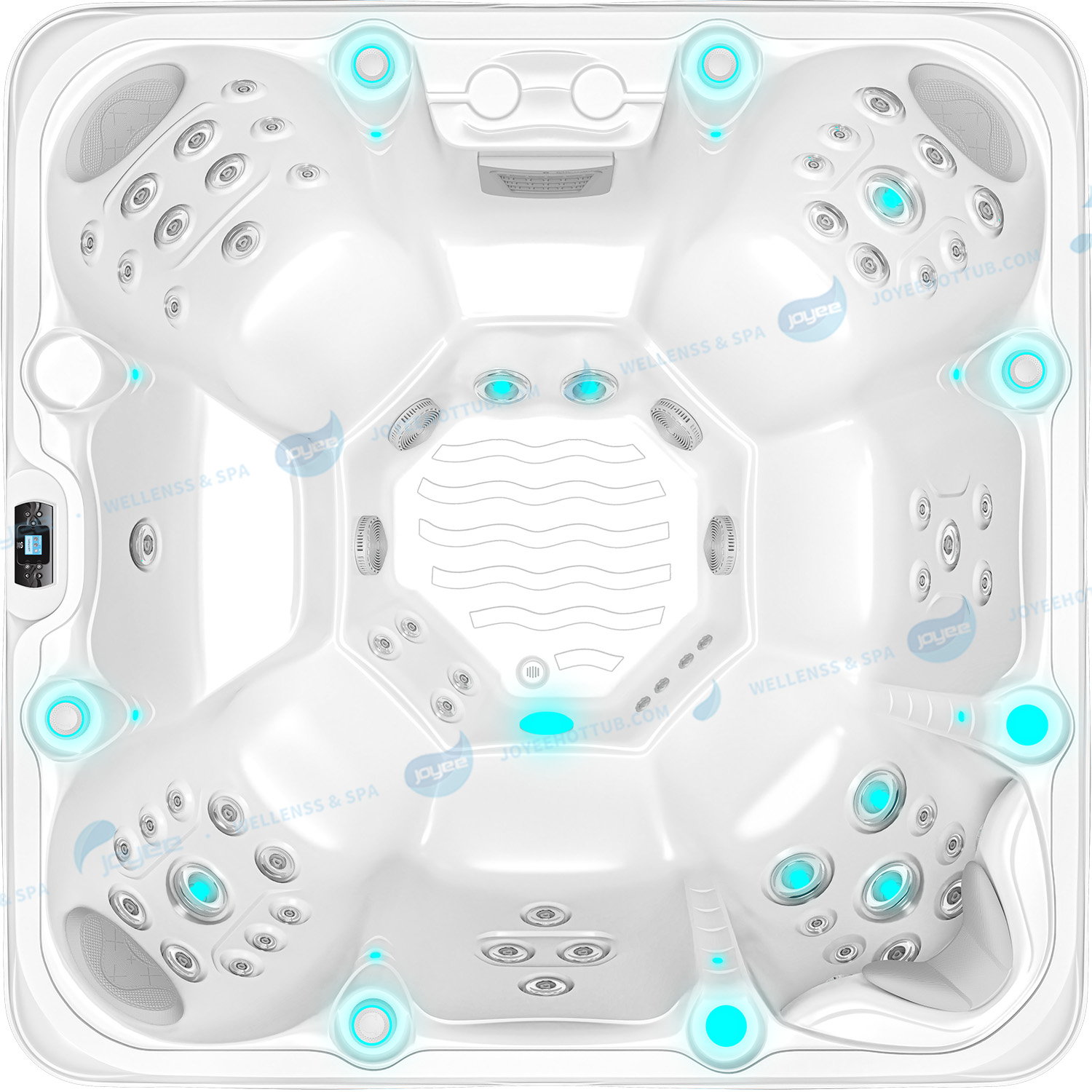
Vetting wholesale partners requires strict due diligence. A reliable hot tub bulk supplier offers more than just discounted pricing. You need a factory-direct relationship. Request verifiable commercial client references. Speak with other property managers about their equipment longevity. Ask about the supplier's response times during peak seasons and their ability to handle warranty claims efficiently.
Transparency regarding manufacturing origins is critical. Many suppliers import unbranded shells and assemble them domestically. Others manufacture the entire unit overseas. You must verify the origin of internal components. Ensure the supplier uses globally recognized pumps, heaters, and acrylics. Purchasing an 8 person hot tub wholesale demands complete component transparency to guarantee future parts availability. Request a detailed bill of materials before signing a purchase order.
Differentiate between simple drop-shipping and full-service commercial supply. Drop-shippers leave the unit at your curb. Your facility team assumes all responsibility for moving, wiring, and starting the equipment. This approach introduces significant risk. Improper initial setup frequently damages pumps and heaters due to airlocks in the plumbing.
Choose a supplier that offers or coordinates dealership-level hookup. Initial system commissioning involves priming pumps, balancing water chemistry, and programming filtration cycles. A premium supplier connects you with a local network of certified technicians. Access to local service ensures rapid repairs. Extended downtime directly impacts your property's revenue and guest reviews. The supplier should provide a dedicated account manager to coordinate local service calls.
Warranty terms dictate your long-term financial risk. Never assume a residential warranty applies to your property. Most manufacturers include strict warranty void clauses. Placing a residential unit in a commercial setting instantly voids all coverage. Manufacturers track commercial addresses and deny claims accordingly.
Demand a dedicated commercial warranty document. Read the fine print carefully. A standard commercial warranty should cover the shell structure for at least five to seven years. Surface coverage against blistering should last three to five years. Plumbing and electronics typically carry one to two years of commercial coverage. Ensure the warranty covers both parts and authorized labor. Clarify who pays for freight when shipping replacement parts to your facility.
Global supply chains impact delivery schedules and maintenance. Custom factory-direct manufacturing often requires 12 to 16 weeks of lead time. Plan your procurement cycle well in advance of peak booking seasons. Ask the supplier about their domestic warehousing capabilities. Suppliers with regional distribution centers can fulfill orders in days rather than months.
Parts availability dictates your maintenance downtime. Proprietary jets, custom pillows, and specific circuit boards often face shipping delays. Choose a supplier that maintains domestic stock of critical replacement parts. Request a recommended spare parts list. Keep backup heater elements, filter cartridges, and pump seals on site. This proactive approach prevents extended out-of-order periods and keeps your amenities open for guests.
Installing an 8 person outdoor hot tub requires robust infrastructure. Powering multiple high-horsepower pumps and a titanium heater simultaneously demands significant electricity. Standard 110V plug-and-play connections cannot support commercial units. You must install dedicated 240V, 50-60 Amp GFCI circuits. Hire a licensed commercial electrician. They must run heavy-gauge copper wiring (typically 6 AWG) from the main breaker to an external disconnect box located within sight of the spa.
Structural load calculations prevent catastrophic property damage. Water weighs 8.34 pounds per gallon. An eight-person unit holds roughly 500 to 650 gallons. Add the dry weight of the equipment and the weight of eight adults. The total structural footprint often exceeds 6,000 pounds. Ground-level installations require a reinforced concrete pad. Specify a minimum thickness of 6 inches with a 4,000 PSI rating. Reinforce the slab with a steel rebar grid. Ensure the pad slopes slightly (1/4 inch per foot) for proper drainage routing away from the equipment compartment.
Moving a massive commercial spa requires professional logistics. These units easily measure 90+ inches across and weigh over 1,000 pounds dry. Standard delivery crews cannot navigate tight property lines or elevated decks. You must measure all access clearances. Check gate widths, overhead branches, and sharp corners along the delivery path.
Commercial property installations frequently require crane services. Craning a unit over a building or retaining wall mitigates property damage. It protects the spa frame from stress fractures caused by improper lifting. Hire professional riggers experienced in spa placement. They use specialized spreader bars and nylon straps to prevent crushing the acrylic lip during the hoist. Verify their insurance coverage before they lift the equipment onto your property.
Improper chemical management destroys equipment and endangers guests. High acid levels corrode heater elements and pump seals within weeks. Low sanitizer levels lead to bacterial outbreaks. You cannot rely on guesswork in a commercial setting. Staff must understand the relationship between pH, alkalinity, and sanitizer efficacy.
Establish strict Standard Operating Procedures (SOPs) for your maintenance staff. Mandate daily water testing using professional-grade liquid drop test kits, not basic test strips. Staff must log pH, alkalinity, and sanitizer levels every morning. Implement a strict filter rotation schedule. Keep two sets of filters. Clean one set while the other operates. Establish quarterly drain-and-fill schedules. Document all maintenance activities to satisfy health department inspections and protect against liability claims.
A successful commercial hot tub investment relies on prioritizing durable components over the lowest initial price tag. Specify industry-standard materials like Aristech acrylic, Gecko or Balboa controls, and composite cabinetry. Ensure strict adherence to local health code compliance. Reliable wholesale support guarantees your equipment remains operational during peak seasons.
Apply strict shortlisting logic when evaluating suppliers. Immediately disqualify vendors who cannot provide commercial-specific warranties. Reject suppliers lacking transparent component sourcing. Avoid companies that fail to offer dedicated post-sale technical support and local commissioning networks. Your property's reputation depends on equipment reliability.
Take the following actionable steps to finalize your procurement strategy:
Audit your site's electrical capacity and structural load limits with licensed contractors.
Consult your local municipal health department for commercial pool and spa code requirements.
Request detailed specification sheets, plumbing schematics, and commercial warranty documents from shortlisted bulk suppliers.
Order backup consumable parts, including filters and pump seals, alongside your initial equipment purchase.
A: Standard footprints range from 90x90 inches to 94x108 inches. Heights fall between 36 and 40 inches. You must add at least 36 inches of clearance around the equipment access panels. Maintenance staff need this space to reach pumps, heaters, and drain valves without obstruction during routine service.
A: In-ground installations offer a seamless aesthetic and easier accessibility for guests with mobility issues. However, freestanding above-ground units provide superior maintenance access. Above-ground installations allow technicians to easily reach plumbing and equipment panels, significantly reducing repair times and labor costs during component failures.
A: No. Using a residential unit commercially introduces severe legal and liability risks. It instantly voids the manufacturer warranty. Residential units lack the rapid filtration and automated sanitation required to meet commercial health codes. Health inspectors will flag these units, leading to potential fines and immediate facility closures.
A: A true eight-passenger unit requires at least two high-horsepower jet pumps, typically 3 to 5 HP each. This configuration adequately powers 40 to 60 jets. A single pump cannot maintain adequate water pressure across all seats when the spa is fully occupied by guests.
A: Calculate the total weight by adding the dry weight, water volume weight, and average bather weight. A standard unit weighs roughly 1,000 pounds dry. Five hundred gallons of water adds 4,170 pounds. Eight adults add about 1,400 pounds. A fully loaded unit typically weighs between 6,000 and 7,500 pounds.
A: Draining frequency depends on bather load and total water volume. In high-traffic settings, you must drain, clean, and refill the unit every one to four weeks. Always follow local health department regulations regarding mandatory water replacement schedules to prevent bacterial outbreaks and cloudy water conditions.
